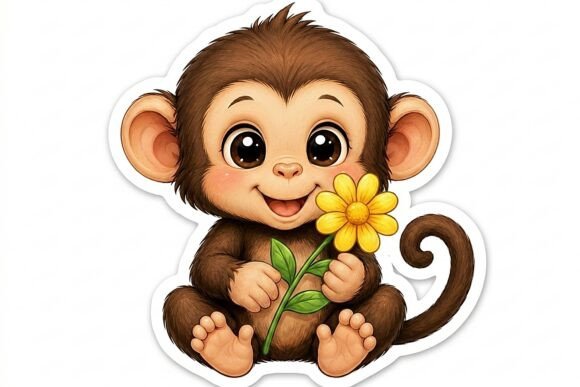
Cute Baby Monkey with Yellow Flower Stic
Thoughtful visual design isn’t just about aesthetics—it’s a functional tool for clarity, connection, and consistency. The Cute Baby Monkey with Yellow Flower Stic is more than a charming chibi-style illustration; it’s a versatile, high-fidelity digital asset engineered for intentionality. Its transparent-background PNG format, kawaii sensibility, and clean vector-derived rendering make it suitable not only for craft projects but for strategic communication—where tone, audience alignment, and execution quality directly impact outcomes.
Why This Design Fits Real Work—Not Just Play
When you choose a sticker like the Cute Baby Monkey with Yellow Flower Stic, you’re selecting a micro-element of visual language. That matters—especially if your work involves education, wellness, early childhood services, creative entrepreneurship, or community-facing content. A well-placed, emotionally resonant image can lower cognitive load, reinforce brand warmth, and signal approachability without words. For example, educators integrating this into printable behavior charts or emotion cards find children respond faster to recognition cues when visuals feel familiar and kind—not generic or overly stylized.
Similarly, small business owners using sublimation or print-on-demand products report higher engagement when playful yet polished motifs like this appear on nursery blankets, baby milestone cards, or planner inserts. It’s not novelty driving results—it’s recognition value. The yellow flower adds a subtle but intentional contrast: warm, optimistic, and grounded in natural symbolism without cliché. That balance—cuteness with restraint—is what makes the Cute Baby Monkey with Yellow Flower Stic adaptable across contexts rather than confined to one niche.
Strategic Use Cases Beyond Decoration
Consider how the Cute Baby Monkey with Yellow Flower Stic functions in systems—not just as isolated graphics:
- Digital journaling: Used as a gentle progress marker in habit trackers, it softens the pressure of self-accountability. Users report staying consistent longer when milestones feel celebratory rather than clinical.
- Client-facing templates: Therapists, lactation consultants, and pediatric occupational therapists embed it in intake forms or session summaries to reduce perceived formality—especially helpful with neurodivergent clients or families navigating early intervention.
- Branded resource kits: Freelancers building digital product suites (e.g., printable parenting guides or classroom SEL tools) use it to unify visual identity across PDFs, Canva templates, and social media previews—without needing custom illustration budgets.
- Nursery or classroom decor: When printed at scale and mounted with care, its transparency allows seamless layering over textured wallpaper or fabric backdrops—supporting sensory-informed environments where visual clutter is minimized by design.
None of these uses depend on “cute for cute’s sake.” Each leverages the asset’s technical readiness—high-resolution PNG, no background, instant download—and its emotional resonance in service of a specific objective.
What to Evaluate Before Deployment
Before adding the Cute Baby Monkey with Yellow Flower Stic to your workflow, ask three questions:
- Does it serve a defined function—or just fill space? If it appears only because “it matches the color scheme,” pause. Visual cohesion matters, but purpose matters more. A sticker used without intent dilutes attention and weakens message hierarchy.
- Is the audience likely to interpret its tone as supportive, not infantilizing? Kawaii aesthetics carry cultural weight. In professional or therapeutic settings, test reception with representative users. Some parents appreciate its lightness; others may prefer more neutral or culturally specific motifs. Context determines appropriateness.
- Will scalability and legibility hold up? Though the file is high-quality, resizing below 1.5 cm in print or under 48px in digital interfaces risks losing detail in the flower stem or facial expression. Always preview at final output size—not just on screen.
These aren’t barriers. They’re checkpoints—designed to ensure the Cute Baby Monkey with Yellow Flower Stic strengthens rather than obscures your goals.
Integrating It Into Longer-Term Systems
One-time use has limited ROI. The real leverage comes from embedding the Cute Baby Monkey with Yellow Flower Stic into repeatable, scalable workflows:
- Template libraries: Save layered PSD or Figma files with this sticker pre-positioned in common layouts—greeting card fronts, weekly planner headers, or digital worksheet corners. Reuse saves time and ensures consistency.
- Brand extension guidelines: If you manage multiple products (e.g., a line of toddler learning apps + printable resources), define where and how this motif appears—e.g., “only on reward-based interactions” or “exclusively in non-clinical materials.” That prevents visual fatigue and maintains meaning.
- Customer experience touchpoints: Add it subtly to email signature badges, downloadable checklist footers, or confirmation screens. Not as decoration—but as a quiet signal of continuity between digital and physical interactions.
This level of integration transforms a single graphic into part of your operational infrastructure—supporting memory, trust, and recognition over time.
Risks of Misaligned Application
Without clear goals, even a well-designed asset like the Cute Baby Monkey with Yellow Flower Stic can backfire. Overuse in formal documents—like grant proposals or academic presentations—may unintentionally undermine credibility. Similarly, placing it adjacent to serious health information (e.g., vaccination handouts) without thoughtful framing can create dissonance between tone and content.
Another risk lies in assumption: that “cute” universally signals safety or inclusivity. It doesn’t. In multilingual or multicultural contexts, floral motifs or primate imagery may carry unintended connotations. Always cross-check with local advisors or community reviewers—not as a compliance step, but as a practice of precision.
Making It Work for Your Specific Context
Start small. Pick one high-impact, low-risk use case: a printable monthly habit tracker for your coaching clients, a set of themed Google Slides templates for parent workshops, or a batch of thank-you cards for volunteer teams. Apply the Cute Baby Monkey with Yellow Flower Stic deliberately—centered, sized appropriately, and paired with ample white space. Then observe response: Do people comment on its warmth? Does it improve completion rates on worksheets? Does it increase shares of your digital resources?
Let evidence—not instinct—guide expansion. If metrics improve or qualitative feedback highlights emotional resonance, scale thoughtfully. If not, revisit the fit: Is the motif mismatched with audience expectations? Is placement competing with key information? Adjust before replicating.
The Cute Baby Monkey with Yellow Flower Stic works best not as a decorative afterthought—but as a considered element in a larger system of communication, learning, or care. Its value multiplies when treated as a tool—not a trend.