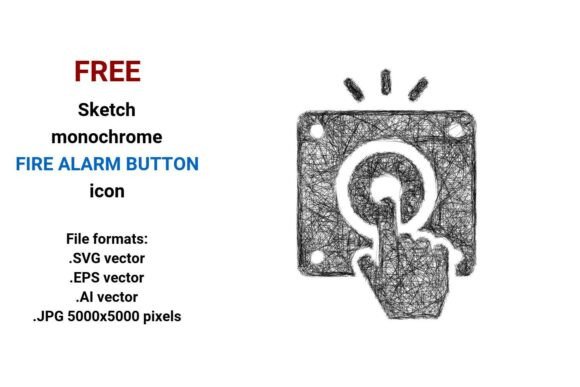
FREE Sketch Fire Alarm Button Icon
Need a fire alarm button icon that feels human, intentional, and instantly recognizable—yet flexible enough for professional use? The FREE Sketch Fire Alarm Button Icon delivers exactly that: a clean, hand-drawn-style vector icon rooted in clarity and function. Unlike generic flat icons or over-polished 3D renders, this design uses confident, monochrome strokes—evoking the urgency of an emergency button while preserving visual warmth and approachability. It’s not just decorative; it’s communicative.
This resource includes four production-ready file formats: .SVG (ideal for web UIs and responsive sites), .EPS and .AI (for print, branding, and scalable vector editing in Adobe Illustrator), and a high-res .JPG at 5000×5000 pixels (perfect for large-format signage, presentations, or mockups). All files share the same core sketch aesthetic—consistent line weight, subtle irregularity, and balanced negative space—so your designs stay cohesive across platforms.
Why a Sketch-Style Fire Alarm Button Works So Well
A fire alarm button isn’t just a symbol—it’s a trigger for action. In safety-critical contexts, users need to recognize intent *immediately*. A sketch-style rendering supports that goal by balancing familiarity with distinction. Its hand-drawn quality avoids visual fatigue (common with overused flat icons), while its monochrome outline ensures legibility on any background—dark mode interfaces, printed manuals, industrial control panels, or classroom posters.
Because it’s built as a vector image, every curve, corner, and stroke scales infinitely without blurring or pixelation. Whether you’re placing it on a 16-pixel toolbar icon or a 6-foot-tall evacuation diagram, the integrity remains intact. That’s not just convenient—it’s essential for accessibility, compliance, and long-term brand consistency.
Creative Applications Across Real Projects
Designers and educators have already adapted the FREE Sketch Fire Alarm Button Icon in ways that go beyond literal interpretation:
- Interactive eLearning modules: Embedded in clickable hotspots for fire safety simulations—its sketch style softens the intensity of emergency topics while keeping focus sharp.
- Small business signage: Printed on laminated wall decals for cafes, co-working spaces, or daycare centers—paired with custom typography to match local branding.
- UI kits and design systems: Used as a foundational alarm button component in Figma or Adobe XD libraries—developers appreciate the clean SVG paths and consistent artboard sizing.
- Infographics and public awareness campaigns: Layered into illustrated safety checklists, where its hand-drawn character creates visual harmony with other sketched elements like exits, extinguishers, or smoke detectors.
- Prototyping hardware interfaces: Applied to mockups of physical control panels or IoT dashboards—its outline style reads clearly at small sizes and integrates smoothly with technical wireframes.
Adapting for Different Audiences and Goals
What makes this icon especially useful is how easily it adapts—not through editing, but through thoughtful pairing and context.
For educators and trainers: Use the .JPG version in slide decks or PDF handouts. Its 5000×5000 resolution means no scaling artifacts when zooming during live instruction. Pair it with short, active-language labels (“Pull in case of fire”) to reinforce behavior—not just recognition.
For web developers and UX designers: Drop the SVG directly into HTML or CSS. Its minimal path data keeps load times low, and its transparent background works seamlessly with dynamic themes. Add hover states or focus outlines using CSS—no extra assets needed.
For marketers and small business owners: Import the .AI file into Canva or Illustrator to recolor selectively (e.g., red fill inside the outline for urgency, or brand-color accents on supporting text). Because the base is black-and-white, color adjustments stay precise and reproducible.
For hobbyists and makers: Print the EPS version onto vinyl for custom control panel overlays, or laser-cut it from acrylic for tactile interface prototypes. Its bold stroke width translates cleanly to physical media—no fine-detail loss.
Keeping Your Use Clear, Consistent, and Audience-Friendly
Even the best icon can lose impact if misused. Here’s how to preserve its strength:
- Maintain contrast: Always place it against a solid, light or dark background—not busy textures or gradients. The sketch style relies on clear silhouette reading.
- Respect scale hierarchy: Don’t shrink it below 24px in digital interfaces. At smaller sizes, details blur and recognition drops—even with perfect vectors.
- Pair intentionally: Avoid stacking multiple sketch-style icons without visual breathing room. Let this fire alarm button icon anchor a section—then use simpler symbols (like arrows or checkmarks) elsewhere.
- Test real-world legibility: Print a sample at intended size and view it under typical lighting—especially if used in low-light or high-stress environments.
More Than Just an Icon—A Design Decision
Choosing the FREE Sketch Fire Alarm Button Icon signals attention to both craft and consequence. It’s not about chasing trends—it’s about selecting a visual tool that aligns with how people actually process information in urgent moments. Its hand-drawn authenticity builds trust; its vector precision ensures reliability; its monochrome simplicity removes distraction.
You don’t need to be a professional designer to benefit from it. Whether you’re updating a school’s safety webpage, prototyping a smart building dashboard, or illustrating a community preparedness guide—the icon gives you a strong, ethical starting point. And because it’s free and openly licensed for personal and commercial use, there’s zero friction between idea and implementation.
Download the .SVG for your next website update. Open the .AI file to tweak spacing for a custom dashboard layout. Print the .JPG for a training poster that stands out without shouting. However you use it, let the sketch style remind you: clarity isn’t cold—and urgency doesn’t require noise.