FREE Sketch Yellow Card Icon: A Practical, Scalable Asset for Designers and Developers
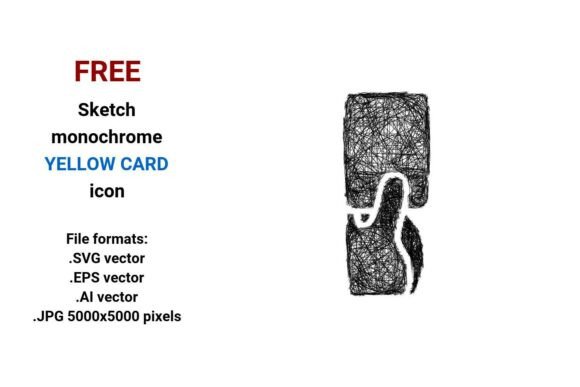
The FREE Sketch Yellow Card Icon is a deliberately understated yet highly functional design resource — not a flashy stock element, but a purpose-built vector asset tailored for clarity, adaptability, and real-world implementation. It represents a yellow warning card as used in sports officiating, rendered in a hand-drawn sketch style that balances recognizability with creative flexibility. Unlike photorealistic or overly stylized alternatives, this icon leans into minimal line art: rough pencil strokes, subtle unevenness, and intentional imperfection — all preserved across scalable vector formats. Its value lies less in novelty and more in consistency, compatibility, and contextual fit.
What You Get — And Why Format Choice Matters
This package delivers four distinct file types: .SVG, .EPS, .AI, and .JPG (5000×5000 pixels). That combination covers nearly every production need. The vector formats (.SVG, .EPS, .AI) retain full editability and infinite scalability — critical when adapting the same icon across app UIs, print signage, responsive websites, or large-format displays. The high-resolution JPG serves as a reliable fallback for platforms that don’t support vectors natively, or when quick previews, presentations, or social media assets are needed without vector software.
Each vector version maintains clean paths and ungrouped layers — no embedded raster effects or hidden objects. That means designers can recolor the stroke in seconds, adjust line weight for different screen densities, or isolate elements for animation. The .SVG exports cleanly with proper viewBox attributes and minimal inline styling, making it safe for direct embedding in HTML or integration into React/Vue components. The .AI file opens reliably in modern Adobe Illustrator versions without font or missing plugin errors — a practical detail often overlooked in free resources.
Design Integrity Meets Functional Clarity
The sketch aesthetic isn’t just decorative — it supports usability. In interface design, a hand-drawn yellow card icon signals “warning” or “caution” without triggering alarm fatigue. Its outline-based construction ensures legibility at small sizes (e.g., 24×24 px in a dashboard toolbar), while retaining character at larger scales (e.g., 200×200 px on an educational infographic). The deliberate roughness avoids sterile uniformity, helping the icon stand out in minimalist layouts without competing visually with core content.
It’s also semantically coherent. The shape reads instantly as a yellow card — not a generic rectangle or abstract symbol. There’s no ambiguity around its association with fouls, referee decisions, or moderation actions. That clarity matters whether you’re building a sports analytics dashboard, a classroom behavior tracker, or a community platform’s moderation UI. Users don’t pause to decode meaning; they recognize intent immediately.
Real-World Use Cases and Audience Fit
Freelance UI/UX designers working on sports-related SaaS tools frequently need consistent, licensable icons that avoid copyright risk. This FREE Sketch Yellow Card Icon fills that gap — especially when clients request a “human” or “approachable” visual tone. Educators building classroom management apps use it to indicate warnings or behavior prompts without resorting to harsh red icons or generic exclamation marks. Marketing teams developing fan engagement campaigns integrate it into email templates or micro-interactions where authenticity matters more than polish.
Small business owners managing community forums or membership sites find it useful for flagging guideline violations. Because it’s delivered as both vector and high-res raster, they can drop it directly into Canva, Figma, or WordPress without needing design support. Developers appreciate the clean SVG path data — no unnecessary nodes, no stray anchor points — which keeps bundle sizes low and rendering predictable across browsers and devices.
Where It Performs Well — And Where to Pause
This icon excels in contexts where tone, scalability, and licensing simplicity matter most. It holds up well in dark-mode interfaces (stroke-only design avoids fill contrast issues), works across branding systems with warm or neutral palettes, and integrates smoothly into design systems that prioritize hand-crafted or “authentic” visual language.
However, it’s not ideal for every scenario. If your project requires strict adherence to WCAG 2.1 AA contrast standards *without* custom color adjustment, the default black-on-white sketch may need manual tweaking — though that’s trivial in vector editors. It also assumes some familiarity with vector workflows; users relying solely on drag-and-drop website builders without SVG support will need to use the JPG version, sacrificing scalability for convenience. And while the sketch style adds warmth, it may feel incongruous in ultra-formal or corporate environments leaning heavily into precision geometry or corporate minimalism.
Practical Integration Tips
- For web developers: Embed the SVG inline for full CSS control over stroke color and hover states — e.g., changing from black to amber on interaction.
- In Figma or Adobe XD: Import the .SVG or .AI file and convert to components. Use variants to represent “active,” “disabled,” or “hover” states with minimal effort.
- For print or presentation: Use the .EPS or high-res JPG. The 5000×5000 pixel JPG ensures crisp output even on large banners or projector slides.
- When customizing: Adjust line weight between 1–2 px for digital interfaces; 3–4 px for print or large displays. Avoid filling the shape unless your design system explicitly supports solid-color variants — the outline form is its strongest identity.
Long-Term Value and Licensing Reality
This is a genuinely free resource — no attribution required, no hidden paywalls, no email gate. That transparency builds trust, especially for professionals who’ve encountered “free” assets buried under restrictive licenses or unexpected usage limits. Because it’s built as clean vector geometry, it ages well: no reliance on outdated fonts, no embedded bitmap textures that degrade with updates, and no dependency on third-party plugins or cloud services.
That longevity translates to workflow efficiency. Once integrated, it doesn’t require rework during redesigns or platform migrations. Whether you’re updating a mobile app’s icon set next year or expanding a moderation dashboard in two years’ time, the FREE Sketch Yellow Card Icon remains usable — unchanged in quality, consistent in meaning, and ready for reuse without legal review.
It won’t replace a full icon system, nor does it claim to. But as a single, well-executed, context-aware element — one that bridges warning semantics with approachable aesthetics — it delivers focused utility. For anyone balancing speed, clarity, and creative authenticity in digital or print communication, it’s a quietly effective tool worth keeping in the asset library.