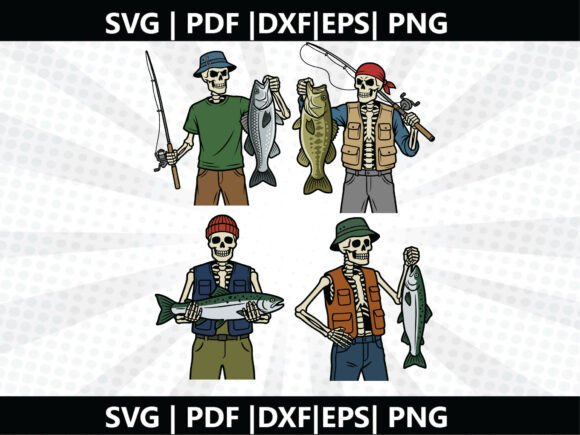
Skull Fisher SVG Cricut Cut File: A Versatile Vector Asset for Makers Across Disciplines
Vector design files are the backbone of modern digital crafting—especially for those who rely on precision, scalability, and cross-platform compatibility. Among niche yet widely adopted motifs, the Skull Fisher SVG Cricut Cut File stands out not just for its visual intrigue, but for its functional versatility across creative workflows. Unlike static raster graphics, this file delivers clean, mathematically defined paths that retain fidelity at any size—making it equally effective for a 2-inch iron-on transfer or a 36-inch wall decal. Its name hints at a stylized fusion: a skull motif layered with fishing iconography—think bait hooks, net textures, or wave-inspired negative space—rendered in bold, cut-ready outlines.
Why Vector Fidelity Matters Beyond the Cutting Mat
A well-structured vector file like the Skull Fisher SVG Cricut Cut File isn’t merely “printable” or “cuttable”—it’s engineered for repeatability and adaptability. Each node is intentionally placed; curves are smooth and minimal; overlapping paths are resolved. This reduces common pain points: jagged edges during small-scale cuts, excessive weeding time on intricate interiors, or distorted output when scaling beyond default dimensions. For educators leading craft-based STEM units, that reliability means students spend less time troubleshooting software errors and more time iterating on design thinking. For small business owners producing limited-run merchandise, it means consistent quality across batches—no re-tracing or manual cleanup needed between t-shirt and tote bag applications.
Real-World Applications Across Creative Sectors
The practical utility of the Skull Fisher SVG Cricut Cut File extends far beyond hobbyist t-shirt customization. Its balanced composition—neither overly dense nor excessively sparse—lends itself to diverse substrates and production methods:
- Apparel & Wearables: When applied to cotton-blend tees using heat-transfer vinyl (HTV), the design’s open interior spaces minimize material waste and reduce peel-and-press effort. On performance fabrics like polyester hoodies, the crisp line weight ensures durability through repeated washing without fraying or pixelation.
- Drinkware & Home Goods: Transferred onto ceramic mugs via sublimation, the 300dpi PNG variant retains edge clarity even around curved surfaces. Paired with a UV-resistant coating, the same SVG can be laser-etched onto wooden coasters or acrylic shelves—leveraging the included DXF format for Glowforge or CNC compatibility.
- Educational & Community Projects: Art teachers use the EPS version in Adobe Illustrator to deconstruct symmetry, layering, and negative space concepts. Band moms repurpose elements—like the hook or skull silhouette—as modular components in parade banners or instrument decals, resizing without distortion thanks to native vector behavior.
- Event & Personal Branding: Wedding planners incorporate subtle iterations—monochrome versions, simplified outlines—into custom napkin prints or signage. Baseball fans merge the fish motif with team colors and logos, using Design Space’s weld and contour tools to integrate text seamlessly.
Cross-Platform Compatibility as a Workflow Accelerator
One of the most underappreciated strengths of the Skull Fisher SVG Cricut Cut File lies in its multi-format packaging. Rather than forcing users into a single ecosystem, it anticipates real-world tool diversity:
- The SVG file integrates natively into Cricut Design Space, Silhouette Designer Edition, and browser-based editors like Vectr—ideal for quick edits or color swaps before cutting.
- The DXF version bridges the gap for users of Silhouette Studio Basic Edition (which lacks SVG import) and industrial tools like laser cutters. Its lack of embedded styling makes it predictable for CNC path generation.
- EPS serves professionals needing editable anchor points in Illustrator or Inkscape—useful for modifying stroke weights, converting strokes to outlines, or preparing press-ready CMYK separations.
- The PNG at 300dpi with transparent background functions independently of cutting machines altogether—perfect for digital invitations, social media assets, or mockup overlays in Canva or Photoshop.
- Even the PDF isn’t an afterthought: it preserves vector integrity for high-resolution printing on letter-size documentation or classroom handouts, avoiding rasterization artifacts.
This breadth eliminates format-switching friction. A maker can begin sketching layout ideas in Silhouette Studio, export to PDF for client review, then switch to Cricut Design Space for final cut settings—all without reimporting or redrawing.
User-Centric Design Considerations
Technical soundness alone doesn’t guarantee usability. The Skull Fisher SVG Cricut Cut File reflects deliberate choices aligned with how people actually create:
First, weeding efficiency. Interior details—such as eye sockets or hook bends—are spaced to allow standard weeding tools to pass cleanly. No micro-loops or nested paths trap vinyl scraps. This matters especially for beginners or those managing volume production, where cumulative time savings add up significantly.
Second, scalability without compromise. Because all elements are true vectors—not traced bitmaps—the file supports extreme resizing. A user can enlarge the skull to 18 inches for a garage door mural and shrink the hook element to 0.5 inches for a keychain charm, both retaining identical line consistency and corner sharpness.
Third, color-agnostic structure. There are no embedded gradients or effects that break upon import into basic software. Colors can be reassigned freely in Design Space or Silhouette Studio, enabling rapid prototyping of seasonal palettes—deep navy and kelp green for fall fishing events, bright coral and teal for summer tournaments.
Integration Into Broader Creative Workflows
For business owners, the Skull Fisher SVG Cricut Cut File functions as a foundational asset—not a one-off decoration. It becomes part of a scalable product system: paired with complementary designs (e.g., tackle box icons, water ripple borders), it forms a cohesive collection for Etsy shops or local craft fairs. Educators embed it into lesson plans on marine biology or regional folklore, prompting students to research species native to local fisheries and annotate designs with scientific names.
Hobbyists combine it with photo-realistic textures—applying wood grain overlays to the skull shape in Procreate, then exporting as PNG for layered vinyl application. Researchers studying visual symbolism in Americana use the motif to examine how mortality and recreation coexist in vernacular art, leveraging the clean vector lines for comparative analysis across historical fishing posters.
Practical Implementation Tips for Diverse Users
To maximize return on this resource, consider these context-specific approaches:
- For Cricut users: Use the “Flatten” function only when preparing for Print Then Cut—otherwise, keep layers ungrouped to adjust individual element colors or positions.
- For educators: Import the SVG into Inkscape, then use “Path > Object to Path” to convert strokes, allowing students to manipulate node handles and observe Bezier curve behavior firsthand.
- For small batch producers: Save multiple versions of the DXF in varying sizes (e.g., 4”, 6”, 9”) to avoid on-the-fly scaling during production runs—reducing calibration drift on laser cutters.
- For hybrid crafters: Layer the transparent PNG over printed fabric with a lightbox and trace by hand for embroidery patterns, using the clean edges as stitch guides.
Long-Term Value Beyond Immediate Use
Digital design assets depreciate quickly if they’re rigid or outdated. The Skull Fisher SVG Cricut Cut File avoids obsolescence through modularity and neutrality. Its stylistic balance—bold enough to read at a distance, detailed enough to reward close inspection—ensures relevance across trends. It doesn’t rely on fleeting typography or seasonal filters. Instead, it offers structural integrity: a reliable starting point that adapts to evolving tools, materials, and audience expectations.
Whether used to personalize gear for a youth fishing derby, embellish handmade journals for a coastal writing retreat, or prototype packaging for an eco-conscious tackle brand, the file supports intentionality—not just decoration. That distinction is what separates disposable clipart from enduring creative infrastructure.