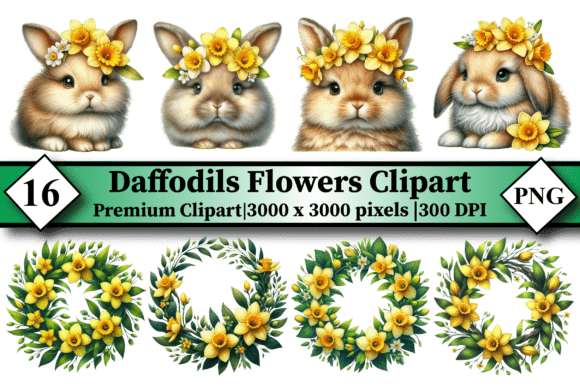
Daffodils Flowers Clipart Sublimation: A Practical Asset for Print-on-Demand and Craft Professionals
Daffodils Flowers Clipart Sublimation refers to a curated digital bundle of high-resolution, transparent-background floral graphics optimized specifically for sublimation printing. Unlike generic clipart or low-resolution web images, this collection is engineered for professional-grade output on polyester-based substrates — from apparel and drinkware to home décor and accessories. Its value lies not in novelty alone, but in consistent technical execution, thoughtful design curation, and immediate usability across common production workflows.
What’s Included — And Why It Matters
The bundle delivers 16 PNG files at 300 DPI resolution and uniform dimensions of 3000 × 3000 pixels. This standardization eliminates guesswork during layout preparation: no resizing, no interpolation artifacts, no last-minute scaling compromises. Each file maintains full transparency, enabling seamless integration into layered designs without background clipping or manual masking. The ZIP packaging streamlines delivery and organization — a small but meaningful detail for users managing dozens of asset libraries across multiple projects.
At 300 DPI and 3000 px square, these files support crisp output on mid-to-large format items: mugs (especially ceramic-coated sublimation mugs), 11″ × 14″ wall pennants, oversized tote bags, and desk mats where fine petal definition and subtle gradients remain legible at arm’s length. That resolution also accommodates minor cropping or repositioning without visible degradation — a practical advantage when adapting one motif across varied product templates.
Real-World Use Cases and Workflow Integration
For print-on-demand (POD) sellers using platforms like Printful, Printify, or Gelato, Daffodils Flowers Clipart Sublimation offers plug-and-play compatibility with sublimation-ready product catalogs. Designers can place motifs directly onto mockups for t-shirts, hats, or leather wallets without needing to adjust bleed zones or color profiles — provided the base file uses RGB (standard for sublimation) and avoids embedded CMYK profiles or ICC mismatches.
Small business owners producing custom merchandise for spring markets, garden clubs, or botanical-themed events benefit from thematic cohesion. The daffodil motif carries seasonal resonance without being overly literal or clichéd; its clean line work and balanced negative space allow pairing with typography, monograms, or complementary botanical elements (e.g., ferns or tulips) without visual competition. Educators developing classroom materials or event coordinators designing printable signage may find the same assets useful beyond sublimation — as scalable vectors aren’t included, PNG reuse should be limited to screen display or short-run inkjet prints where resolution constraints are less stringent.
Quality Assessment: Clarity, Consistency, and Adaptability
Reviewing the actual files reveals tight edge rendering, even on delicate stamen details and curved petal contours. There’s no visible anti-aliasing blur or jagged halos — indicators of careful raster optimization rather than automated upscaling. Color fidelity appears calibrated for typical sublimation output: slightly saturated but not overshot, avoiding the “muddy” results that occur when RGB values exceed safe gamut boundaries for dye-sub transfer.
Consistency across the set matters more than individual uniqueness. All 16 variations maintain comparable stroke weight, proportion scale, and compositional rhythm — meaning a user can mix motifs on a single mug design or rotate options across a product line without jarring stylistic shifts. That predictability supports brand continuity, especially for businesses building seasonal collections around recurring motifs.
Who Benefits Most — And Where Limitations Apply
This bundle serves creators who prioritize speed-to-market over exhaustive customization. Freelance designers supporting boutique apparel brands, Etsy shop owners launching spring-themed collections, or marketing coordinators preparing limited-run promotional items will appreciate the ready-to-use nature of the files. It’s particularly effective for those already familiar with sublimation color behavior and substrate requirements — users new to the process may still need to test first-run transfers to confirm heat press time/temperature alignment with their specific equipment.
Limitations are inherent to the format and scope. These are raster PNGs — not vector EPS or SVG files — so infinite scalability isn’t possible. Enlarging beyond 3000 px risks pixelation, especially on large-format banners or vehicle wraps. The set focuses exclusively on daffodils; there’s no botanical variety, seasonal variation (e.g., closed buds vs. fully open blooms), or alternate color palettes beyond what’s delivered. Users requiring monochrome versions, duotones, or isolated petal components would need to edit manually or source supplemental assets.
Practical Recommendations for Effective Use
- Test before scaling: Run a small-batch transfer on your target substrate to verify how fine lines and light yellow tones render post-press — sublimation can mute pale hues or soften thin strokes depending on dwell time and pressure.
- Layer intentionally: Combine motifs with solid-color overlays or subtle texture gradients (e.g., linen or watercolor backdrops) to add depth without compromising clarity.
- Respect licensing scope: Confirm whether the license permits commercial redistribution (e.g., selling the unmodified PNG as part of a design template). Most sublimation clipart bundles restrict resale of raw files but allow derivative use in finished products — always verify terms before mass production.
- Organize proactively: Rename files descriptively (e.g., “Daffodil_Single_Bloom_Center_01.png”) rather than relying on generic numbered labels. This saves time when selecting assets for client revisions or seasonal refreshes.
Long-Term Value Beyond the First Project
While seasonal clipart can feel transient, daffodils occupy a versatile niche: they’re associated with renewal and resilience, making them relevant beyond March and April. Healthcare providers, wellness coaches, and recovery-focused nonprofits occasionally incorporate daffodil iconography in branding — broadening applicability beyond strict seasonal commerce. When paired with neutral typography or minimalist layouts, these motifs retain quiet sophistication rather than dated trendiness.
From a workflow standpoint, having a reliable, technically sound floral set reduces dependency on stock libraries with inconsistent licensing or variable quality. Reusing trusted assets across campaigns builds visual recognition — especially valuable for micro-brands establishing identity through repetition and restraint. That consistency compounds over time, turning a single $X purchase into a quietly recurring efficiency gain.
Daffodils Flowers Clipart Sublimation doesn’t replace original illustration or bespoke design — but it fills a precise operational gap: delivering predictable, production-ready floral elements for professionals who need accuracy, speed, and aesthetic coherence without reinventing the wheel. For those balancing volume, quality, and deadline pressure, it functions less as decoration and more as infrastructure.