Free Sketch-Style Plug Type Icons: Scalable Vector Resources for Designers & Developers
Whether you're designing a smart home dashboard, building an IoT device interface, or creating educational materials about electrical standards, plug type icons play a quiet but essential role in digital communication. Among the most versatile and widely adopted options are free sketch-style plug type icons — hand-drawn, monochrome, scalable vector assets that blend technical clarity with human-centered design.
What Is a Sketch Plug Type Icon?
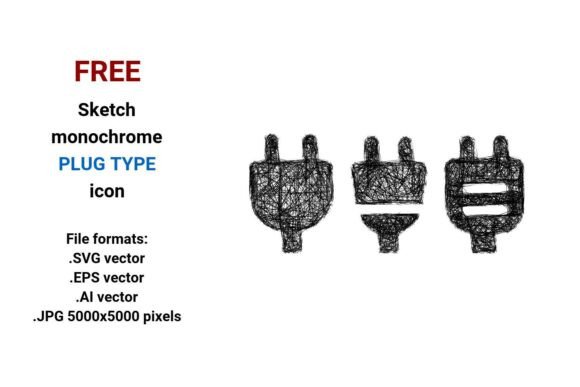
A sketch plug type icon is a stylized, black-and-white visual representation of a physical plug or connector, rendered in a loose, hand-drawn sketch aesthetic. Unlike photorealistic or flat UI icons, these icons use scribble lines, subtle curves, and intentional imperfections to evoke authenticity, approachability, and creative energy.
They’re not just decorative — they serve functional purposes: labeling input ports on hardware schematics, illustrating compatibility in product documentation, or guiding users through setup flows in web and mobile applications. When labeled as a plug type button or connector type button, they often act as interactive UI elements — clickable toggles or status indicators in dashboards, configuration panels, or diagnostic tools.
Why Vector Format Matters: SVG, EPS, AI, and High-Res JPG
These free icons come in four key file formats: .SVG (Scalable Vector Graphics), .EPS (Encapsulated PostScript), .AI (Adobe Illustrator native), and a high-resolution .JPG (5000×5000 pixels). Each serves a distinct purpose — and together, they ensure seamless integration across platforms and workflows.
- .SVG: The gold standard for web use. Renders crisply at any size, supports CSS styling and animation, and loads quickly. Ideal for website interfaces, responsive dashboards, and modern UX sketch icon systems.
- .EPS: A legacy but still vital print-ready format. Preferred by manufacturers and technical illustrators who need precise output for manuals, packaging, or PCB silkscreens.
- .AI: Fully editable in Adobe Illustrator. Lets designers adjust stroke weight, anchor points, or color fills — perfect for customizing a scalable sketch icon to match brand guidelines.
- .JPG (5000×5000 px): A high-fidelity raster fallback. Useful for presentations, printed posters, or environments where vector support is limited — while preserving fine outline sketch icon detail thanks to its ultra-high resolution.
This multi-format availability makes the resource uniquely practical — whether you're a frontend developer embedding an interface sketch icon in React, an educator preparing a STEM slide deck, or an industrial designer specifying a plug standard in a spec sheet.
Understanding “Plug Type” vs. “Connector Type”: Clarity Starts With Terminology
It’s easy to assume plug and connector are interchangeable — but in engineering and UX contexts, precision matters.
A plug is typically the male, movable end — like the prongs on a power cord. A connector is the broader category: it includes both plugs (male) and jacks/receptacles (female). So a plug type refers to the physical configuration (e.g., Type A, Type C, IEC 60320 C13), while connector type may describe the full mating system (e.g., USB-C connector family, RJ45 Ethernet connector).
That’s why our free sketch black and white plug type icon set includes variations representing common international plug standards: North American NEMA 1-15, European CEE 7/7, UK BS 1363, and universal USB-C. Each is drawn with consistent line art fidelity — so users instantly recognize form factors without relying on color cues.
Real-World Applications: Beyond Decoration
Sketch-style icons aren’t just for mood boards. Their playful sketch icon quality builds trust and reduces cognitive load — especially when explaining technical concepts to non-experts.
- Educational Platforms: Physics or electronics courses use sketch illustration icons to visualize circuit diagrams, grounding symbols, or adapter compatibility — making abstract plug standard differences tangible.
- Smart Device Interfaces: Home automation apps display a sketch plug type button to let users assign devices to outlets. The sketch aesthetic signals “this is configurable,” not “this is locked hardware.”
- Technical Documentation: Engineers embed digital sketch icon variants into datasheets and API references — e.g., showing which GPIO pin corresponds to a “USB-C power delivery connector type” — with clarity and visual consistency.
- Design Systems: Teams adopt interface sketch icon libraries as part of a larger sketch design element strategy — unifying wireframes, prototypes, and final UIs under one expressive, human-scale language.
Debunking Common Misconceptions
Misconception #1: “Sketch icons aren’t professional.”
Not true. Leading tech companies — from Tesla’s vehicle UI to GitHub’s hardware docs — use hand-drawn sketch assets to signal approachability, iteration, and user focus. A scribble icon doesn’t mean “unfinished”; it means “designed for people.”
Misconception #2: “Vector = only for logos.”
Vectors are foundational to modern digital design. Because they’re defined by math — not pixels — a plug type vector can scale from a 16×16 favicon to a 10-foot trade show banner without blurring or distortion. That’s impossible with even the highest-res JPG alone.
Misconception #3: “Black and white means low utility.”
Monochrome sketch icons offer unmatched flexibility: they adapt to dark/light modes, support accessibility contrast requirements, and integrate cleanly into data visualizations, infographics, and schematic overlays — all without clashing with brand color palettes.
How to Use These Icons Responsibly & Effectively
Even free resources deserve thoughtful implementation:
- Pair with clear labels: A sketch pictogram of a Type G plug should accompany text like “UK Standard (230V)” — never rely solely on visual recognition.
- Test at multiple sizes: Ensure your scalable sketch icon remains legible as a 24px toolbar item and a 120px modal header.
- Respect licensing: These are free sketch plug type icon resources — but always verify usage rights. Most permit personal, educational, and commercial use — just avoid reselling the raw files as your own.
- Optimize SVGs for web: Run downloaded .SVGs through tools like SVGO to reduce file size without sacrificing quality — critical for fast-loading web icon performance.
Final Thoughts: Why This Resource Fits Modern Design Needs
In an era of AI-generated perfection and hyper-polished interfaces, there’s growing appreciation for human-centered design cues. A pen-drawn, curves-based, black and white plug icon doesn’t hide complexity — it invites understanding. It bridges the gap between engineering rigor and everyday usability.
Whether you call it a plug type icon, a connector type button, or simply a sketch design element, this resource delivers more than pixels or paths. It delivers clarity, flexibility, and context — all in four open, editable, future-proof formats.
So next time you’re mapping out a device onboarding flow, drafting a cross-border compliance guide, or teaching students about global plug standards, reach for a free sketch black and white plug type icon. Not just because it’s free — but because it’s thoughtfully built for how people learn, interact, and make sense of technology.