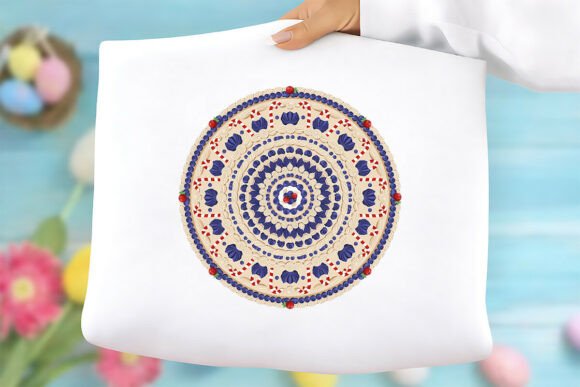
Red White Blue Decorative Circle PNG: A Practical Guide for Designers and Makers
A Red White Blue Decorative Circle PNG is a ready-to-use digital graphic element designed with patriotic color symbolism—red, white, and blue—arranged in a balanced, circular composition. Unlike generic clipart or vector illustrations, this specific file is delivered as a high-resolution PNG at 300 DPI, with a transparent background and no watermark. It’s optimized for immediate integration into physical product workflows, from screen-printed apparel to ceramic mug decals, without requiring design software expertise.
What Sets This Red White Blue Decorative Circle PNG Apart
The defining traits of this file lie in its technical execution and licensing clarity—not visual complexity. Its 300 DPI resolution ensures crisp output even when scaled up to 8×8 inches for large-format prints. The transparent background eliminates manual clipping or layer masking, saving time during mockup creation or production prep. Because it’s delivered as a single PNG file (not SVG, EPS, or layered PSD), it avoids compatibility issues across platforms—whether you’re using Canva, Adobe Express, Cricut Design Space, or basic photo editors like GIMP or Preview.
This isn’t a customizable template or editable source file. There are no vectors, no adjustment layers, no font files—just one clean, final raster image. That limitation becomes an advantage when consistency matters: every user receives the exact same pixel-perfect rendering, eliminating version drift or unintended edits that can occur with editable formats.
How It Compares With Other Formats and Approaches
Designers often weigh PNGs against SVGs, JPEGs, or custom-drawn assets. Each has tradeoffs:
- SVG alternatives offer infinite scalability and editability—but require vector software proficiency and may render inconsistently across older print RIPs or web browsers. An SVG might let you recolor segments individually, but it won’t guarantee uniform output on a heat-transfer press unless properly rasterized first.
- JPEG versions of similar designs are widely available, but lack transparency. That means adding a white circle behind your design just to mask a background—a step that increases file size, complicates layering, and risks misalignment in multi-element layouts.
- Custom illustration gives full control over line weight, spacing, and stylistic nuance—but demands time, skill, and often licensing review if referencing existing motifs (e.g., stars, stripes, or heraldic arrangements). For time-sensitive projects—like holiday-themed merchandise launching in under two weeks—a pre-vetted, commercially licensed PNG delivers reliability without iteration.
Unlike generative AI outputs, this Red White Blue Decorative Circle PNG comes with clear usage terms: commercial use on physical goods is permitted, but redistribution of the digital file is prohibited. That distinction matters when evaluating long-term brand safety. AI-generated graphics may carry ambiguous rights or hidden training-data conflicts; a curated, rights-cleared PNG offers documentation and predictability.
Real-World Fit: When This PNG Works Well—and When It Doesn’t
This file excels in scenarios where speed, consistency, and legal clarity outweigh the need for customization. Consider these examples:
- A small-batch t-shirt printer preparing Fourth of July inventory uses the Red White Blue Decorative Circle PNG as a central chest logo. They resize it once, test print on three fabric types, then lock in the placement—no reworking needed across 50 SKUs.
- A school PTA designing spirit wear for a parade orders 200 vinyl-cut stickers. The transparent background allows clean application over colored backpacks or water bottles, without visible edges or halo effects.
- An Etsy seller creating printable wall art bundles includes the circle as a subtle border accent on greeting cards and posters—scaling it down to 1.5 inches wide without pixelation.
It’s less suitable when precise color matching is critical across substrates. While the RGB values are fixed, CMYK conversion for offset printing may shift perceived saturation slightly—especially in red tones. If your project requires Pantone-matched branding (e.g., corporate event swag), you’d need to adjust the file manually or commission a color-managed version.
Similarly, if your workflow depends on cutting machines that rely on vector paths (like some Roland or Graphtec plotters), a PNG requires raster-to-vector tracing—an extra step that can degrade edge fidelity. In those cases, sourcing or commissioning an SVG equivalent makes sense, provided you verify its commercial license scope.
Understanding the Licensing Boundaries
The commercial license attached to this Red White Blue Decorative Circle PNG permits use on physical end products sold to customers—t-shirts, mugs, tote bags, enamel pins, etc. You retain full rights to the finished item you produce. What’s prohibited is sharing, reselling, or redistributing the original PNG file itself—whether as a standalone download, embedded in a design template, or included in a “design bundle” for resale.
This aligns with industry-standard digital asset licensing, but differs meaningfully from subscription-based marketplaces where usage rights reset monthly or vary by plan tier. Here, the license is perpetual and tied to your purchase—no recurring fees, no usage caps, no attribution requirements. However, it doesn’t extend to digital resale: you can’t sell the PNG as part of a Canva template pack or upload it to Creative Market as your own design.
Scalability and Technical Readiness
At 300 DPI, the file supports common print sizes without interpolation. At full native dimensions (typically ~4000×4000 pixels), it scales cleanly to:
- 13.3" × 13.3" at 300 DPI (ideal for large posters or banners)
- 8.5" × 11" at 300 DPI (standard letter-size printouts)
- 3.5" × 3.5" at 300 DPI (perfect for sticker sheets or iron-on transfers)
Because it’s a flat raster image, there are no embedded fonts, linked assets, or external dependencies. You open it, place it, and export—no missing elements or broken links. That simplicity reduces friction for users who aren’t designers by trade: teachers making classroom decorations, crafters building DIY kits, or small business owners managing their own social media visuals.
Making the Right Choice for Your Project
Ask yourself three questions before selecting this Red White Blue Decorative Circle PNG:
- Do I need guaranteed transparency and consistent output across multiple devices or printers? If yes, PNG is more reliable than JPEG or unoptimized web graphics.
- Is my priority speed and legal certainty—not granular control over every curve or color stop? Then a finalized PNG saves hours versus editing vectors or troubleshooting AI outputs.
- Will this be applied to physical goods I manufacture or sell directly? The included commercial license covers exactly that—no additional permissions required.
If your answer to all three is “yes,” this file fits efficiently into your workflow. If you need editable layers, Pantone-specific color builds, or vector precision for die-cutting, consider supplementing it with professional design support—or sourcing a complementary SVG version elsewhere.
Ultimately, the value of the Red White Blue Decorative Circle PNG lies not in novelty, but in thoughtful execution: high resolution, clean delivery, transparent licensing, and real-world readiness. It’s a tool built for makers who prioritize dependable results over speculative features—supporting creativity without demanding expertise.