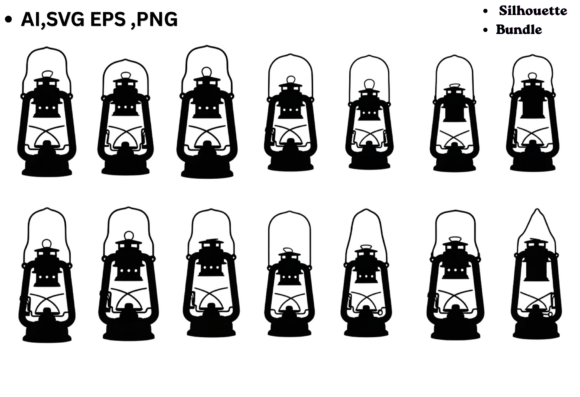
Vintage Lantern Silhouette SVG Bundle
Designing with intention means starting from a place of clarity—not just about the final look, but how each asset moves through your workflow. The Vintage Lantern Silhouette SVG Bundle fits precisely into that space: it’s not just decoration. It’s a production-ready vector resource built to integrate cleanly into planning, execution, and delivery stages across physical and digital creative work.
Whether you’re preparing holiday window displays for a boutique, designing printable classroom materials for a history unit on 19th-century lighting, or developing a cohesive brand motif for an artisan candle line, this bundle serves as a functional node in your process—not an afterthought. Its value isn’t isolated to aesthetics; it lies in consistency, scalability, and compatibility across tools you already use.
Where It Fits in Your Creative Workflow
This bundle enters your process at multiple points—before, during, and after core tasks—depending on your role and objective.
Before a project begins: When scoping a new craft initiative—say, launching a seasonal product line—you’ll likely map out visual themes, material constraints, and output formats early. The Vintage Lantern Silhouette SVG Bundle supports that planning phase by offering predictable, production-grade assets. You can test scale, layer composition, and color treatment in Illustrator before committing to vinyl cuts or print runs. That reduces guesswork later.
During execution: If you’re using a Cricut Maker or Silhouette Cameo for custom signage, the included SVG file loads directly into Design Space or Silhouette Studio Designer Edition without conversion steps. No tracing, no manual path cleanup—just clean cut lines ready for precise blade movement. For sublimation projects on ceramic mugs or fabric banners, the high-resolution PNG with transparent background drops straight into Canva or Photoshop for layout refinement. There’s no need to adjust DPI or re-rasterize.
After delivery: Clients or collaborators often request editable source files for future updates. The AI and EPS files in the bundle meet that expectation professionally. You retain full control over anchor points, stroke weight, and grouping logic—critical when adapting the lantern silhouette for variations like engraved wood signs (where line thickness affects router depth) or embroidered patches (where simplified paths reduce stitch count).
Integration Across Tools and Teams
Compatibility isn’t theoretical—it’s operational. This bundle works where your tools live:
- Cutting machines: SVG files are validated for Cricut Design Space (v7+), Silhouette Studio Designer Edition (v5.4+), and Brother ScanNCut CanvasWorkspace. No scaling artifacts, no missing layers—tested with default cut settings on standard 12” x 12” mats.
- Vector editors: EPS and AI files open natively in Adobe Illustrator (CC 2020+) and CorelDRAW (2021+). All paths are outlined, fonts are converted to curves, and layers are named logically (e.g., “Lantern_Body”, “Flame_Detail”)—so team members can isolate elements without reverse-engineering.
- Print & digital platforms: The 300 DPI PNG renders crisply on Etsy listings, Shopify product pages, and PDF handouts. Because the background is transparent, it composites cleanly over photos, textures, or gradients—no extra masking required.
For teams managing shared asset libraries, the consistent naming convention (lantern-silhouette-01.svg, lantern-silhouette-01.ai) helps maintain organization across cloud folders or DAM systems. No renaming, no version confusion.
Practical Implementation Tips
Here’s how experienced users apply this bundle efficiently—without slowing down:
- Batch prep for seasonal inventory: One user—a small-batch home goods seller—imports the SVG into Cricut Design Space, duplicates the lantern silhouette four times, resizes each to 2”, 4”, 6”, and 8”, then saves them as separate project files labeled by size. When prepping for fall markets, they pull the exact file needed instead of resizing on the fly—cutting setup time by ~60% per item.
- Layered design for multi-material projects: A woodworker uses the AI file to separate the lantern outline (for laser-cutting plywood) from the interior flame detail (for engraving). They assign different line weights and colors in Illustrator, then export two distinct SVGs—one for cut, one for engrave—matching machine-specific requirements.
- Educational reuse: A middle school art teacher imports the PNG into Google Slides, groups it with historical context text and discussion prompts, and shares the slide deck with students. Later, she exports the same slide as a PDF for printing station worksheets—no quality loss, no font substitution issues.
Quality Control and Long-Term Use
Vector integrity matters most when scaling across applications. Every shape in the Vintage Lantern Silhouette SVG Bundle was manually reviewed for open paths, overlapping nodes, and inconsistent stroke alignment—common causes of jagged cuts or rendering errors. That means:
- No unexpected gaps when scaled to 24” for wall decals.
- No stray anchor points that cause misalignment in layered embroidery designs.
- No embedded raster elements that degrade when exported to web formats.
Because the files are fully editable, you’re not locked into one interpretation. Need a weathered texture? Apply a grain effect in Illustrator to the lantern body layer only. Want to simplify for children’s coloring pages? Delete the flame detail group and save a new SVG variant. These adjustments preserve original fidelity—no generational loss.
Preparing for Smooth Adoption
To avoid friction, consider these setup actions before your first use:
- Verify software versions: Ensure your cutting machine software or vector editor meets minimum version requirements listed in the bundle documentation. Older versions may not support newer SVG features like nested groups or non-uniform scaling.
- Test one file type first: Start with the SVG in your preferred cutting software. Run a quick cut on scrap material to confirm registration marks align and blade pressure settings match the file’s path complexity.
- Organize your local folder: Create a dedicated subfolder (e.g.,
/assets/vintage-lantern/) and copy all four file types there. Add a simpleREADME.txtnoting intended uses—“SVG = vinyl cut”, “PNG = web/social”, etc.—so future-you (or a teammate) knows the purpose without opening each file. - Check commercial license scope: The bundle permits both personal and commercial use, but verify whether your specific application falls within permitted categories (e.g., selling physical items made with the design is allowed; reselling the SVG files themselves is not). Keep the license summary accessible in your project notes.
Finally, treat this as a foundational element—not a one-off. Save modified versions with descriptive names (lantern-silhouette-wreath-combo.svg, lantern-silhouette-embroidery-stitch.svg) so you build a reusable library over time. That turns a single purchase into ongoing leverage across seasons, clients, and platforms.
The Vintage Lantern Silhouette SVG Bundle doesn’t replace skill or strategy. It removes avoidable friction—so your focus stays where it belongs: solving real problems, meeting deadlines, and delivering work that reflects your standards, not software limitations.