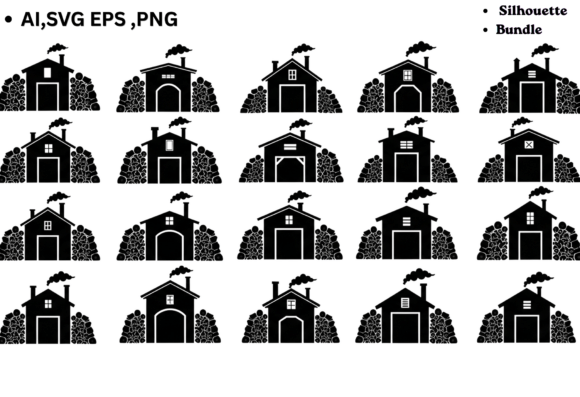
Wood Shed Silhouette SVG Bundle: A Precision Digital Asset for Diverse Creative Workflows
Across studios, classrooms, small workshops, and home-based design businesses, vector-based silhouette assets have evolved from simple decorative elements into foundational tools for production-grade creativity. The Wood Shed Silhouette SVG Bundle exemplifies this shift—not as a standalone graphic, but as a thoughtfully engineered digital resource built for adaptability, fidelity, and functional integration. Its value emerges not from aesthetic novelty alone, but from how seamlessly it supports real-world tasks: laser-cut signage for a rural homestead, classroom visual aids for architectural literacy, custom apparel for a heritage-themed boutique, or scalable branding components for a small woodworking business.
Why Vector Silhouettes Matter in Modern Making
Silhouette graphics—especially those representing recognizable structures like wood sheds—function as visual shorthand. They communicate function, context, and materiality at a glance. But not all silhouettes perform equally well across platforms and processes. Raster images (like standard JPGs or low-res PNGs) degrade when enlarged; generic clipart often contains jagged edges, inconsistent stroke weights, or embedded backgrounds that complicate layering. In contrast, the Wood Shed Silhouette SVG Bundle delivers clean, mathematically defined outlines rooted in vector geometry. This means every curve, corner, and cut path is described by coordinates and Bezier handles—not pixels—ensuring sharpness whether scaled to 1 inch for an enamel pin or 48 inches for a wall decal.
This fidelity directly impacts workflow efficiency. Designers using Adobe Illustrator can isolate individual shed components (roof, door, window frame) with the Direct Selection Tool and recolor them independently. Educators preparing printable worksheets on rural infrastructure can embed the SVG directly into InDesign layouts without worrying about resolution mismatches. Laser operators importing the EPS file into LightBurn retain full control over power/speed mapping per vector segment—critical for achieving crisp edge definition on birch plywood or MDF.
File Formats That Align With Real-World Tools and Roles
The bundle’s inclusion of four distinct file types isn’t redundancy—it’s intentional interoperability. Each format serves a specific technical need and user context:
- SVG: The universal web and cutting-machine standard. Fully compatible with Cricut Design Space (via upload), Silhouette Studio Designer Edition (no trace required), Brother ScanNCut CanvasWorkspace, and browser-based editors like Vectr. Its XML structure allows easy editing of fill/stroke attributes via text editors—a boon for developers automating batch customization.
- EPS: The legacy vector workhorse trusted in commercial print environments. Unlike SVG, EPS supports PostScript-level instructions, making it reliable for RIP (Raster Image Processor) software used in large-format printers and engraving systems. Its scalability is absolute—no interpolation, no aliasing, no quality loss at any output size.
- AI: The native Adobe Illustrator source file. Contains layers, named paths, and editable text objects (if applicable), preserving designer intent. Ideal for agencies adapting the shed motif into branded style guides or for educators modifying proportions to demonstrate scale relationships in design fundamentals courses.
- PNG: A 300 DPI raster derivative with alpha transparency. Used where vector import isn’t possible—think PowerPoint presentations, Canva templates, Shopify product mockups, or sublimation previews in Sawgrass Print Manager. Its background-free composition eliminates manual masking, saving time during rapid prototyping.
This multi-format strategy reflects an understanding that creative professionals rarely operate within a single software ecosystem. A small-business owner might draft a social media post in Canva (using the PNG), then prepare a vinyl-cut storefront sign in Silhouette Studio (using the SVG), and finally send final production files to a local print shop that requires EPS for their wide-format printer.
Practical Applications Across User Groups
The versatility of the Wood Shed Silhouette SVG Bundle becomes most apparent when observed across disciplines:
Hobbyists & Home Crafters
For makers using Cricut or Silhouette machines, the clean cut lines eliminate common pain points: nested shapes that fail to separate cleanly, stray anchor points causing double-cuts, or inconsistent line weights leading to uneven weeding. One user reported successfully cutting the shed silhouette from 20-mil magnetic sheeting for a modular workshop organization board—achieving precise alignment across six identical panels because the vector paths maintained consistent spacing at every scale.
Educators & Curriculum Developers
In elementary design technology units, the shed silhouette serves as a scaffolded learning object. Students can import the SVG into Tinkercad, extrude it into a 3D model, then compare structural proportions to real-world shed blueprints. At the university level, landscape architecture students use the AI file as a base layer in GIS overlays, adjusting opacity and color to represent zoning categories or material palettes in site analysis reports.
Small Business Owners & Artisans
A handcrafted furniture maker incorporated the shed silhouette into their logo lockup—using the AI file to align the graphic precisely with custom typography and export print-ready PDF/X-4 files for business cards and packaging. Another vendor selling rustic-themed home goods applied the PNG to heat-transfer vinyl mockups for Etsy listings, ensuring accurate color representation before ordering physical samples. Crucially, the commercial license included with the bundle permits these uses without attribution or royalty obligations—removing legal friction from day-to-day operations.
Technical Considerations for Optimal Use
While the Wood Shed Silhouette SVG Bundle is designed for broad compatibility, certain practices maximize its utility:
- Always ungroup after import: Some cutting software auto-groups layered elements. Ungrouping (Ctrl+Shift+G in Illustrator, right-click > “Ungroup” in Silhouette Studio) ensures individual components—like doors or rooflines—can be resized or recolored independently.
- Check stroke vs. fill settings: For cutting machines, only filled shapes or strokes set to “cut” will register. Avoid applying stroke widths unless intentionally creating outline-only cuts; instead, use the Pathfinder tool to create compound paths for layered effects.
- Verify units in your software: SVG files don’t inherently store physical dimensions—only coordinate space. Always set your document units (inches, mm) before resizing to avoid unexpected scaling during output.
- Leverage transparency intentionally: The PNG’s alpha channel is useful for compositing, but if printing on colored stock, test overprint settings first—some RIPs interpret transparency differently than screen previews.
These aren’t limitations of the bundle itself, but rather acknowledgments of how vector workflows intersect with hardware-specific constraints. Understanding them transforms the asset from a static image into a responsive component within a larger production chain.
Long-Term Value Beyond First Use
Digital assets depreciate quickly when tied to fleeting trends—but functional, well-structured vectors endure. The Wood Shed Silhouette SVG Bundle avoids trend-driven embellishment (e.g., excessive shadows, stylized textures, or seasonal motifs) in favor of structural clarity. Its clean lines translate across mediums: engraved onto leather journal covers, embroidered onto aprons using digitized DST files derived from the AI source, or converted to CNC toolpaths for routing shed-shaped coasters from walnut slab.
Moreover, its instant download delivery supports iterative development. A product designer testing five variations of a garden-tool branding system can import the SVG, modify colors and proportions in under two minutes, and export updated mockups for stakeholder review—all before lunch. That speed compounds across projects, turning what could be a one-time decorative purchase into a recurring operational advantage.
Ultimately, the strength of the Wood Shed Silhouette SVG Bundle lies in its quiet competence: no flashy animations, no forced novelty, just rigorously constructed geometry ready to serve the next idea, the next lesson plan, the next client deliverable—without requiring explanation or compromise.